Writing Documentation for Your House
This has been something I have long thought about for my own house. Keeping a record of every change, improvement, or reference for my house. As with all things I tend to want to do, I tend to overthink it. I have kept my house records very simple. The reality is nobody cares how long your system component has been functioning, just the calculus around fixing versus replacing it. I appreciate the geek level of this linked blog post:
Zen and the Art of Motorcycle Maintenance by Robert M. Pirsig
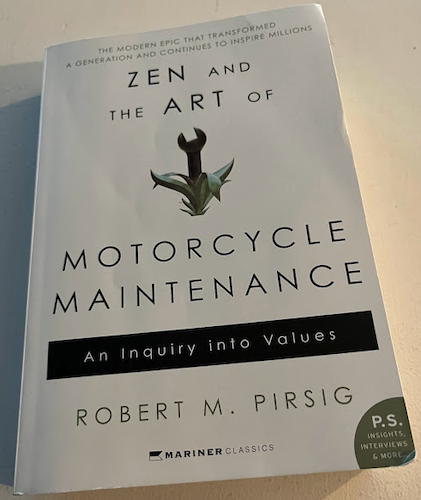
I tried reading this book towards the end of high school or just shortly after. I believe I was able to get three or four chapters in, but it never took off from there. I was also not a reader. Over the past year, this book caught my eye at the bookstore, and have heard it floating around in a few videos and lists, it was time to give it a try. This book is well written, but it is not the book for me. I made it through it all, but I did not have the experience millions of others have had. For me, Shop Class as Soulcraft by Matthew Crawford was a much more meaningful book.
Don't Think, Just Do
I never seek flow in getting things done, I always seek detachment from my monkey mind and just executing on what is in front of me. That is when I am most productive. I do not worry about the order of what needs to be done or the steps to do it or the time it may take or how I might feel. I just pick up the next task and execute. I use a notebook where I will identify the top three most important tasks followed by a running lists of todo’s that come up. Once the most important tasks are complete, if I am smart, I will just pick up the next todo without thinking much about which one should be prioritized.
Writing Documentation for Your House
This has been something I have long thought about for my own house. Keeping a record of every change, improvement, or reference for my house. As with all things I tend to want to do, I tend to overthink it. I have kept my house records very simple. The reality is nobody cares how long your system component has been functioning, just the calculus around fixing versus replacing it. I totally appreciate the geek level of this linked blog post:
Stasis is Not Good Rehab
Sunday I ended up with a spasmed muscle in my lower right back. This resulted in an agonizing day. The rest of the week became recovery from the whole right side of my body tensing and being out of alignment from the one problem. I have been diligent about keeping up my flexibility routine and stretching often throughout the day. I have tried running earlier in the week, but had to temper it with plenty of walking. The challenge is to not overcorrect for worried pain by tensing up. I often found I would have to slow down, calm down, find my breath, and remind my brain that I should relax and not overthink it.
Relationships vs Systems
Working in the engineering world, a common theme is to see people wanting to put systems in place when really we need to cultivate relationships. It is always a mistake to think about working with other people or teams as requiring an interface and system to replace interacting with others. Long term relationships imply trust and empathy.
RIP Charlie Munger
One of the qualities that make Charlie memorable for me is his blunt wit and not his wealth. Perhaps the wealth lead to the wit, but I’d like to think not. I have had Poor Charlie’s Almanac on order for about eight months. It looks to be finally arriving in a week.
Running Sucks
Managing Change
I have always been one to enjoy change. Change often means good things can happen. Change often means a new opportunity to grow, which often comes with pain. We don’t get to choose our change, but we do get to seek out learning from it.
Civilized Progress
It’s sometimes argued that there’s no real progress; that a civilization that kills multitudes in mass warfare, that pollutes the land and oceans with ever larger quantities of debris, that destroys the dignity of individuals by subjecting them to a forced mechanized existence can hardly be called an advance over the simpler hunting and gathering and agricultural existence of prehistoric times. But this argument, though romantically appealing, doesn’t hold up. The primitive tribes permitted far less individual freedom than does modern society. Ancient wars were committed with far less moral justification than modern ones. A technology that produces debris can find, and is find-ing, ways of disposing of it without ecological upset. And the schoolbook pictures of primitive man sometimes omit some of the detrac-tions of his primitive life—the pain, the disease, famine, the hard labor needed just to stay alive. From that agony of bare existence to modern life can be soberly described only as upward progress, and the sole agent for this progress is quite clearly reason itself.